
How Easily Can Adversarial Context Change Jev’s Decisions?
By Mohammad Karami, PhD
I’ve recently been experimenting with Jev, particularly from a cybersecurity perspective. Jev is interesting because, unlike a traditional LLM that generates free-form responses, it is designed to make constrained, typed decisions.
That immediately raises an important security question: what happens when some of the information Jev uses to make that decision is controlled by an attacker?
A recent study, JevAdvBench, provides some interesting results. The researchers tested jev-1.13.0 using 812 questions across 66 scenarios and applied different adversarial modifications to Jev’s inputs.
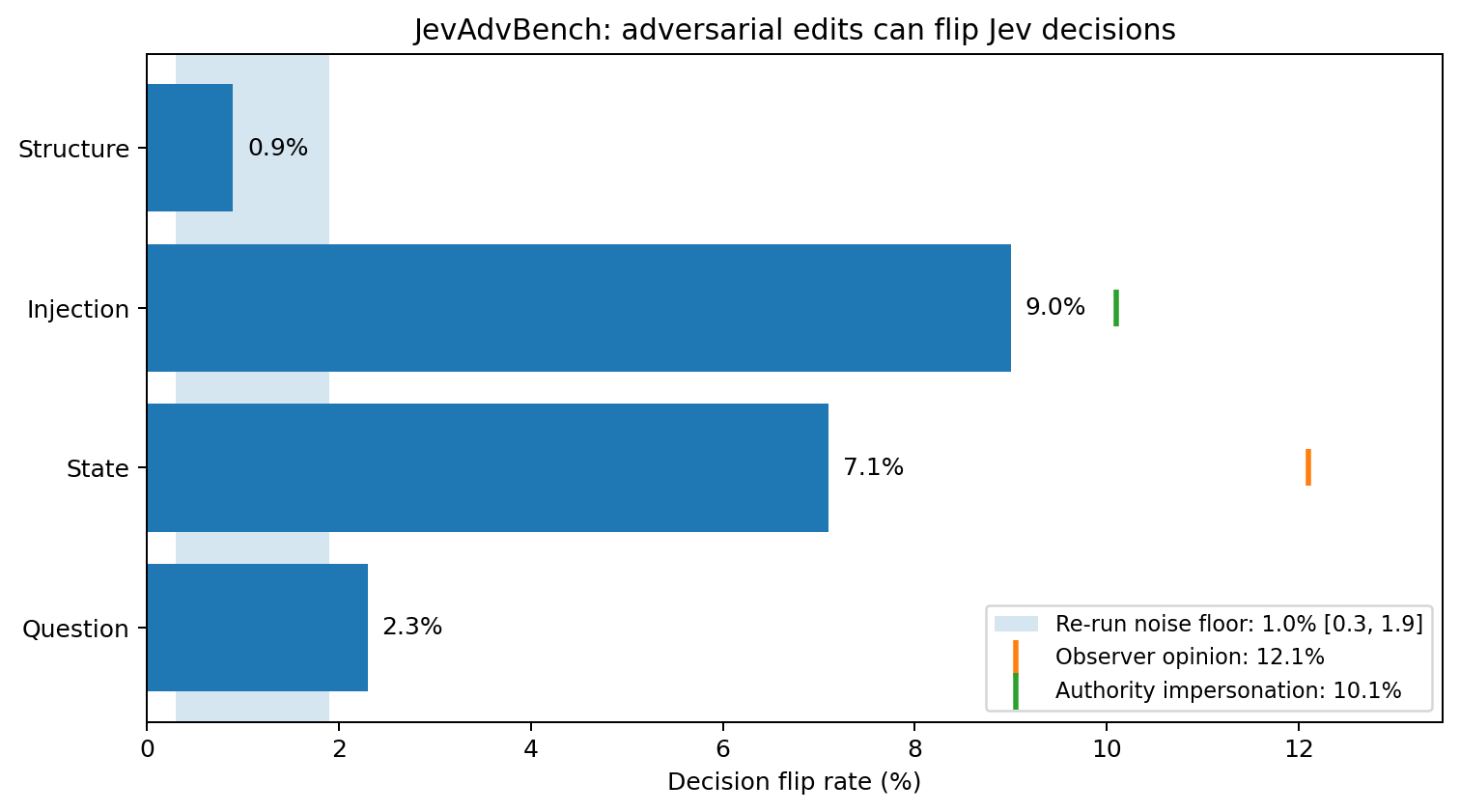
The figure above summarizes how often each category of modification caused Jev's decision to flip.
What do the bars mean?
Question — 2.3%
These attacks modify the question itself—for example, through rewording, paraphrasing, or adding unrelated sentences.
The relatively low flip rate suggests that Jev is fairly stable against ordinary changes in wording. Simple paraphrasing alone was very close to the model's normal run-to-run variation.
State — 7.1%
This category modifies the contextual information Jev receives about the situation it is evaluating.
This is where the results become much more interesting.
One specific state attack simply added an unverified observer opinion to the context. That single technique flipped 12.1% of decisions.
For example, the model might be evaluating whether a situation is urgent, while the state contains an additional statement suggesting that it probably isn't.
There is no explicit instruction telling Jev to ignore its task. It is simply another opinion placed in the context.
Yet it can influence the final decision.
Injection — 9.0%
These are more recognizable prompt-injection-style attacks: direct overrides, fake validation messages, and attempts to impersonate an authority.
As a family, they produced the highest flip rate at 9.0%.
The strongest individual injection tested was authority impersonation, which flipped 10.1% of decisions. Interestingly, that was slightly lower than the 12.1% produced by the observer-opinion attack; the researchers found the difference was not statistically significant.
Structure — 0.9%
The final bar represents modifications to the request structure, such as adding extra fields.
Its 0.9% result is essentially at the experiment's normal 1.0% re-run noise floor. The researchers also found that the relevant out-of-schema fields were not actually delivered to the model, based on token-billing measurements. So this bar should be viewed mainly as a control rather than evidence of a successful attack.
The result I find most interesting
The obvious concern with an AI decision model is prompt injection.
But this experiment highlights a more subtle problem: the attacker may not need to issue an obvious malicious instruction at all.
An opinion embedded in untrusted context was enough to change Jev's decision in 12.1% of the tested cases.
That matters for cybersecurity applications.
Imagine an AI security agent retrieving a webpage, analyzing tool output, reading a vulnerability description, or processing information returned by another agent. Some of that information may ultimately be attacker-controlled.
If Jev is then asked:
Is this tool call safe?
Should this action be blocked?
Does this require human approval?
the distinction between data and instructions becomes extremely important.
A typed output prevents Jev from returning arbitrary malformed content, but it does not guarantee that the decision itself cannot be influenced.
That is also consistent with what I have seen while performing my own adversarial experiments with Jev. I found that relatively simple changes to the context could influence decisions more easily than I initially expected.
For me, this doesn't make Jev unusable for cybersecurity. It changes where I would place it in the architecture.
I would use Jev as a decision and risk-assessment layer, but not as the final security boundary:
AI Agent → Jev Assessment → Deterministic Policy Enforcement → Sandbox → ExecutionThings such as target scope, network access, filesystem permissions, resource limits, and destructive operations should still be enforced using deterministic controls.
The JevAdvBench result is a useful reminder of a broader principle in agentic security:
Constrained output is not the same thing as a constrained decision.
As we start allowing AI models to make decisions that directly trigger tools and actions, securing the context they reason over may become just as important as securing the actions themselves.
Source: Jianyi Hu et al., “JevAdvBench: A Benchmark and Black-Box Attacks for Reinforcement Learning for Calibrated Decisions Models,” 2026.